How not to cheat children: Let them build their own playgrounds
Play Panels, Central Park, 1967, Richard Dattner Architect. Photograph by Norman McGrath.
It wouldn’t be much of a Play Week on Curbed without our resident expert’s take: Critic Alexandra Lange has been all over this beat in recent years, trekking to Noguchi’s last work, a mega-playground in Japan, and highlighting Aldo van Eyck’s progressive Dutch playgrounds. (This summer she also published, ahem, an entire book on the design of childhood, which scales from toy blocks to city blocks.)
Here, we’re excerpting a section from Lange’s book, The Design of Childhood: How the Material World Shapes Independent Kids, that delves into the adventure playground and its history in New York City. That’s right—there was a time in the not-too-distant past when parents let their scamper over concrete ziggurats and build their own play structures with hammers and nails. Intrigued? Read on!
“The next best thing to a playground designed entirely by children is a playground designed by an adult, but incorporating the possibility for children to create their own places within it,” architect Richard Dattner writes at the beginning of his case history for the West Sixty-Seventh Street Adventure Playground, one of five he would eventually design at the periphery of Central Park. Where Kahn and Noguchi failed before him, Dattner and landscape architect M. Paul Friedberg would succeed.
Is Instagram changing the way we design the world?
Yes.
“Designing from Instagram for Instagram seems like a snake eating its own tail. Everywhere looks like everywhere else and the eye grows tired of bananas or concrete tiles or mirror rooms.”
Quoted in The Guardian on architecture and social media.
Concrete utopia: What does our love of brutalist buildings say about us?
Miodrag Zivkovic. Monument to the Battle of the Sutjeska. 1965-71. Photo by Valentin Jeck, courtesy Museum of Modern Art.
First on Tumblr, then on Instagram: frame-filling, deep-shadowed, looming edifices, gray and often looking perpetually damp, pocked by windows, frilled with balconies, enlivened by murals or supergraphics or plants.
But popularity breeds restlessness. Paul Rudolph’s bush-hammered walls? Been there. The Barbican? Done that. Boston City Hall? A thousand op-eds. Flaine? Boutique ski resort. Marina City? Album cover.
The eye needs to travel. So social media gave us more: bigger buildings, more flamboyant and flowing forms, more spectacular settings. Like Yugoslavia: first through the photographs of Jan Kempenaers, widely published in 2013, then through Instagram accounts like _di_ma and socialistmodernism for a daily dose of concrete.
To an American audience the forms, names and locations were strange, adding to the abstraction and the othering headlines: “These 1970s brutalist buildings in Serbia look like Star Wars spaceships,” said Quartz, who filed them under the category “Futuristic Finds.”
It was as if a forest of concrete mushrooms had sprouted and grown to gargantuan size while we were otherwise occupied.
Tell Us 5 Things About Your Book: A Close Look at Where Kids Live, Learn and Play

Alessandra Montalto/The New York Times
A Q&A with John Williams for the New York Times.
Jane Jacobs, the famed urban activist who thought deeply about the streets and spaces where we live, wrote of children: “Their homes and playgrounds, so orderly looking, so buffered from the muddled, messy intrusions of the great world, may accidentally be ideally planned for children to concentrate on television, but for too little else their hungry brains require.” Alexandra Lange quotes this thought from Jacobs in the introduction to her new book, “The Design of Childhood: How the Material World Shapes Independent Kids.” In Ms. Lange’s book, schools, playgrounds, toys and other habitual features of young people’s lives are closely examined: the origins of their design, their strengths and shortcomings, and their short-term and long-term effects on children. Below, Ms. Lange discusses Minecraft and Legos, her surprise at the feminist angle of her book and more.
When did you first get the idea to write this book?
The short answer is I had a baby, in 2007.
Gateway to what?
The entrance to the new visitor center from above. Courtesy Gateway Arch Park Foundation.
The Jefferson National Expansion Memorial Gateway Arch, a 630-foot-tall catenary curve—designed by Eero Saarinen and clad in stainless steel—stands on the west bank of the Mississippi River in St. Louis, Missouri. But really, it stands everywhere in St. Louis.
As you walk downtown, the Arch appears at the end of every broad street, framing rooflines, slipping outside vertical walls, larger and more delicate than any other structure in town. You snap a picture, walk a few blocks, snap another and another. They are all good. There’s no bad side to the Arch. The Arch is perfect.
Should it fall out of sight, some sign or souvenir will remind you where you are, suggesting that you haven’t been anywhere in St. Louis if you haven’t been to the Arch yet. Earrings, keychains, sidewalk stencils, neon beer signs, temporary tattoos, T-shirts. A family of arches for the families that have always flocked to the Arch—albeit, in recent years, in declining numbers. Where once the soaring symbol was a potent enough attraction, now, the city realized, it had become a drive-in, drive-out phenomenon. If St. Louis could get visitors to stay, even for an extra half-day, it could produce the economic equivalent of a second Cardinals baseball season. The answer lay underfoot.
More good press for "The Design of Childhood"
On the radio: I spoke to Courtney Collins on Think, from KERA, and Frances Anderton on Design and Architecture, from KCRW.
Michael Bierut and Jessica Helfand shared a few of their own parenting memories when they talked about the book on The Observatory, and I talked to Failed Architecture about how the book fits into my whole magpie-like career.
On the internet: How highchairs teach good manners, by Sarah Archer at Architectural Digest and the first review, by Allyn West, at the Los Angeles Review of Books.
And at Lifehacker, I tell readers which blocks are best.
An Intellectual History of the Sandbox

Illustration by Doris Liou.
This essay is excerpted from The Design of Childhood: How the Material World Shapes Independent Kids, out now from Bloomsbury.
The first American playground had no climbing bars, no seesaws, no swings. In 1885, a group of female philanthropists decided that the immigrant children of Boston’s North End needed somewhere other than the increasingly crowded and dangerous streets to play. They paid for a pile of sand to be poured into the yard of a chapel on Parmenter Street at the beginning of summer. “Playing in the dirt is the royalty of childhood,” said Kate Gannett Wells, chair of the Massachusetts Emergency and Hygiene Association. The idea came from Germany, where such “sand gardens” were introduced in Berlin’s public parks in 1850 as an offshoot of Friedrich Froebel’s emphasis on the garden part of kindergarten. The success of the first sandpile spurred subsequent summer installations on Parmenter Street and Warrenton Street, each supervised by a matron. By 1887 there were 10 sand gardens, mostly located near the settlement houses that served recently arrived immigrant families. Country children had plenty of dirt, while wealthier city children likely had yards; it was poor children who needed access to free, communal play spaces…
Today, the sandbox has become so familiar that, as Jay Mechling writes in the essay “Sandwork,” “playing with sand in its various states is so universal that the play has become nearly invisible to us, so taken-for-granted that it bumps up against what Brian Sutton-Smith (1970) called the ‘triviality barrier’ of children’s play,” and falls below adult notice. Yet while the digging and sifting are invisible, the tame little sandbox itself has been demonized as unclean, visited after hours by vermin or used as a litter box by cats bearing toxoplasmosis. Like its early playground neighbors, the merry-go-round and the seesaw, equipment that was once trivial has become an endangered species in the urban environment. Once upon a time sand was a little bit of freedom, especially for children whose summers never included a trip to the beach.
Skymall
People slide down the Skyslide in Los Angeles, California. AFP/Getty Images.
We shouldn’t abandon the cities we have for some amenities in the clouds
Raffles City Chonqing, an eight-skyscraper project designed by architect Moshe Safdie and under construction at the meeting of the Yangtze and Jialing rivers, would be just another megaproject in another Chinese megacity were it not for one thing: a ninth skyscraper that’s more like a “sidescraper.”
The roughly 980-foot-long tube, pleated like a lampshade and transparent like a greenhouse, houses a hotel lobby, restaurants, and a public viewing deck, and lies on its side across four of the lesser skyscrapers.
What Safdie began in Singapore with Marina Bay Sands, where three towers are capped by a long, suspended infinity pool, he amplifies in Chonqing. And an architectural conversation that was once explicitly linked to luxury one-upmanship—a pool in the sky—has now taken on a gloss of public-mindedness.
“In these dense cities like Chongqing there’s no room for big public parks [on the ground], so we have to lift them into the sky,” Safdie told the Guardian. Raffles City also includes a “landscaped platform” at a mere six stories, connected to its transit- and retail-rich podium…
Sky this, sky that. The only word more popular in urban branding right now is “line” (as in “High Line”), and there’s already a Skyline Drive. Why the sky? What is the benefit to putting parks, play equipment, cafes, trails, forests up high?
"The Design of Childhood" is out!
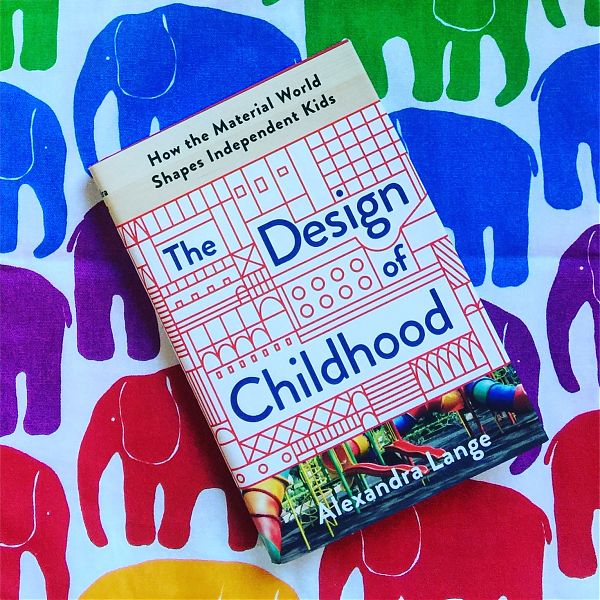
Today is publication day for The Design of Childhood: How the Material World Shapes Independent Kids and I am very pleased to have it out there in the world.
You can check for upcoming book events here. New York City and New Canaan so far, but stay tuned for some Rust Belt city appearances into the fall.
Buy it here or at your local independent bookstore.
Along with the pieces linked in previous posts, today brings more chances to sample the contents.
Architect published an excerpt from my chapter on Schools, focused on project-based learning environments.
The Houston Chronicle published this Q&A, How can we design the world for children?
Google Design produced this thorough podcast, which includes a great list of additional reading.
Yesterday Curbed published this Q&A with Kelsey Keith. Kelsey will be interviewing me tonight at McNally Jackson Books, 76 N 4th Street, Williamsburg. Join us if you can.
Century-Old Decisions That Impact Children Every Day
Illustration by LA Johnson/NPR.
Great story by Anya Kamenetz with amazing classroom history illustrations, plus a book excerpt on blocks, at NPR.
Alexandra Lange’s interest in school design started in her childhood, when she read Little House on the Prairie, with its indelible depiction of Laura’s one-room schoolhouse in Wisconsin.
Today, she’s an architecture and design critic. Her new book, The Design of Childhood, considers the physical spaces where our children learn and grow: from the living room rug crowded with toys, to the streets, welcoming or dangerous, to classrooms, bright and new or dilapidated.
“I felt like a lot of the contemporary discussion about education was really focused on content,” she tells NPR. “In that really tight space in front of the kid’s face. And as someone interested in design I’m always interested in, what kind of room are you in? How much natural light does it get? What kind of materials is it made of? What kind of a chair are you sitting in?”
On X
Follow @LangeAlexandraOn Instagram
Featured articles
CityLab
New York Times
New Angle: Voice
Getting Curious with Jonathan Van Ness