Consider The Fork, Very Carefully
When “Miss Manners’ Guide to Excruciatingly Correct Behavior” was published, in 1982, someone gave my mother a copy for Christmas. I don’t know if she ever looked at it, but I adopted the tome as my Saturday lunch reading, slowly drinking my chocolate milk as I learned the proper invitation style for weddings paid for by the bride and groom, why the use of the suffix V is so rarely acceptable, and that if I got married in January, white velvet would be an option. One of the most curious chapters was the one on table settings, complete with diagrams anatomizing the shape and placement of fish forks, dessert spoons, and one’s monogram. It was clear to me from the amount of real estate devoted to the table that flatware, like weddings, was a locus of high anxiety for adults. I tried to memorize the layout so that, should I be confronted with a bristling array of silver, I would calmly proceed from the outside in.
This is a long way of saying that when the British food writer Bee Wilson’s new book, “Consider the Fork,” arrived at my home, I thought, Consider it done. But what Wilson’s book, subtitled “A History of How We Cook and Eat,” reveals is that long before napkin-on-your-lap (and even napkins) cutlery had the ability to unsettle: “Spoons are what we give babies… Spoons are benign and domestic. Yet their construction and their use has often reflected deep passions and fiercely held prejudices.” During the brief Commonwealth of Oliver Cromwell, the spoon was stripped of the decorative “knop” at the end of the handle, which had been used to depict everything from naked women to Christ and his apostles. The Commonwealth spoon had a shallow bowl and a plain flat stem. Some theorize that they were made heavy as a way of protecting the family’s silver reserve. I think the Roundhead spoons sound a lot like the modernist place settings of Danish silversmith Georg Jensen.
'Wreck-It Ralph' Is a Sweet, Animated Tale About ... Urban Planning?

The best science fiction is deeply architectural, immersing the reader in a fully imagined world leagues different—or lightly tweaked—from ours. Video games, by contrast, traditionally had an out, limiting their pixelated reality by screen edge or vertical scrolling. (What happens to the left and to the right in Tetris? Who cares, you’re distracting me.) But as gaming has become more sophisticated, so has the architecture of the games, pushing the avatars out into spaces with up, down, side-to-side, and even behind.
Technological leaps are often accompanied by nostalgia for simpler times. And so, as the cassette tape (two, maybe three, technologies back) reappears as a design for an iPhone case, the new Disney movie Wreck-It Ralph—$149 million domestic gross and counting—comes along to remind us how sweetly we gamed in the 1980s, and to suggest that HD isn’t all it’s cracked up to be.
3rd Annual Holiday Card Review
After you’ve pushed back from the Thanksgiving table, it will be that time again. Time for Christmas letters, Nordic sweaters, the occasional decoratively-deployed stile. And as in years past, the designs of holiday photo card makers like Minted, Paperculture, Pinhole Press, and Tiny Prints reveal the aesthetic preoccupations of the moment. In 2009, the “Modern” category was anemic, populated by a few red squares and Helvetica greetings. By 2010, it had grown apace, though, as I wrote then, “card designers’ idea of modern runs only to the first string of sans serif fonts: Arial, Avant Garde, Trade Gothic.” Last year I did not see much that was new, and gave the cards a bye. But for 2012, I can identify four key trends that have trickled down from Brooklyn restaurants, across from Pinterest, and through the cloud from Instagram and Facebook. This may be the one time this year most of you buy stamps (I recommend these), and one thing is clear. By our holiday cards, you shall know our social media preoccupations.
A Wide-Angle Lens on the Midcentury American Home
Jennifer A. Watts, left, edited a book on Maynard L. Parker, a photographer of midcentury homes.
The gate of the white picket fence on the cover of the new book “Maynard L. Parker: Modern Photography and the American Dream” (Yale, $65) is ajar, inviting you down a flagstone path. Blue and yellow director’s chairs are set out around a shaded table. The lady of the house hovers at your side; she’s just cut a few flowers.
These elements — casual welcome, outdoor living, brilliant color — were all hallmarks of the midcentury California photographer Maynard L. Parker’s signature style. Mr. Parker, who began his career shooting Hollywood interiors and designer jewels, translated his gift for creating a glamorous narrative into a 30-year career as a photographer of midcentury homes, primarily for House Beautiful. His modern Los Angeles was a very different place from that of his contemporary, Julius Shulman: the houses were smaller and filled with more stuff, the gardens were child-friendly, and the aesthetic, as described by Elizabeth Gordon, editor of House Beautiful from 1941 to 1964, could be labeled “The Station Wagon Way of Life.”
Jennifer A. Watts, photography curator at the Huntington Library, Art Collections and Botanical Gardens, edited the book and oversees the Huntington’s 58,000-image Parker archive. She spoke to a reporter last week by phone from San Marino, Calif.
Knolling Your Polling Place
Many of you are familiar with artist Tom Sachs’s video, #8 in his Ten Bullets series, “Always Be Knolling.” To knoll, inspired by the sort it out, line it up aesthetic of Florence Knoll’s office interiors and Herbert Matter’s Knoll graphics, is to eliminate the unnecessary, group by purpose, and arrange at 90 degrees. Designers do it all the time, and, in my experience, largely unconsciously. I’m looking down at my own desk now: phone and calendar, stacked, on the left. Pad and Post-Its, parallel, on the right. Laptop and screen, center. Books for future projects, stacked by topic, on a nearby surface.
“I Have Seen the Future”: Designer as Showman
Late last week I had the pleasure of attending the tenth biennial Flair Symposium at the Harry Ransom Center at UT Austin. The theme this year was “Visions of the Future,” in conjunction with the exhibition “I Have Seen the Future: Norman Bel Geddes Designs America,” curated by Donald Albrecht. One of the pleasures of the symposium, also one of the pleasures of Geddes’s career, was its diversity. How many ways can you talk about the future? The first panel of the day featured Jen Gunnels, the theater critic for the New York Review of Science Fiction, John Crowley, a science fiction writer, and the director of the University of Houston’s Future Studies program, Peter Bishop. Bishop had my quotable quote of the symposium: “The most important thing in predicting the future is not to get it right, but to present a set of plausible futures. Looking for the right future is a futile exercise. Thinking about the future is like jogging – you end up where you started but in better condition.”
Innovator: Johnston Marklee
The Maison Martin Margiela store in Beverly Hills, California, is Los Angeles architecture studio Johnston Marklee’s flashiest work to date—literally. Completed in 2007, the fashion boutique is covered in what look like metal sequins but turn out to be white plastic disks that gently flutter in the breeze kicked up by traffic on Santa Monica Boulevard. “It is a high-tech effect achieved by low-tech means,” says Mark Lee, who founded the firm with his wife, Sharon Johnston, in 1998.
Finding simple routes to complex architectural pleasures is the pair’s stock-in-trade. Their celebrated residential projects— commissioned by adventurous clients, manipulated from geometric shapes, and named, for the most part, with one suggestive word (Hill, Vault, View)—showcase the strength of thought over luxury. “If we have a secret, it is in how we economize design energy,” Lee says, referring to his office’s tried-and-true tactic of concentrating the wow factor in precise doses as petite as those Margiela paillettes. The results, he explains, are “buildings where people can feel the difference but can’t put their finger on it.”
The Woman Who Invented the Kitchen
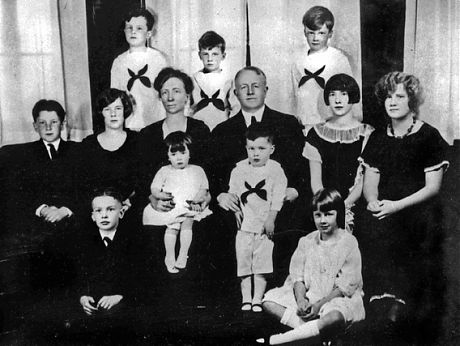
Frank and Lillian Gilbreth with 11 of their 12 children/Purdue Libraries' Archives
The idea that housework is work now seems like a commonplace. We contract it out to housekeepers, laundromats, cleaning services, takeout places. We divvy it up: You cooked dinner, I’ll do the dishes. We count it as a second shift, as well as primary employment. But it wasn’t until the early part of the 20th century that first a literature, and then a science, developed about the best way to cook and clean. The results of this research shape the way we treat housework today, and created a template for the kitchen that remains conceptually unchanged from the 1920s. And the woman who made the kitchen better? She couldn’t cook.
Silicon Island
Can photovoltaics ever be romantic? Morphosis Architects’ design for a new academic building for the Cornell NYC Tech campus, scheduled to open on Roosevelt Island in 2017, suggests the answer could be yes. The in-progress scheme lofts a “lilypad” of photovoltaic cells five stories in the air, covering the roof of Morphosis’ building and bridging a pedestrian street to rest atop a co-location facility (an on-campus business incubator) to be designed by an architect yet to be chosen. By calling it the “lilypad,” Morphosis principal Thom Mayne is trying to get out ahead of the nickname curve, and to suggest that his massive array (a.k.a. “the solar farm”) is more an element of landscape than of architecture. The structure itself is to be the first net-zero building in New York City, fulfilling its own energy needs and acting as a living embodiment of the future of technology. At a recent briefing on the campus master plan, scheduled to begin the city approvals process this week, Mayne said that the array simply has to be that big to produce enough power—though the pad also seems a lot like an older brother’s headlock on to-be-announced Architect #2.
Shopping With Sandro, and Other Tumblr Delights
I recently began following a number of new archival Tumblrs, and want to spread the word.
Top of my list at the moment is the Indianapolis Museum of Art’s Tumblr following the process of digitizing the Miller House and Garden Collection, called Documenting Modern Living. Rather than waiting until every last piece was scanned, or saving the collection for scholars, the IMA (thanks to a $190,000 National Endowment for the Humanities grant), is putting the process and the archival treats out there, day by day. I’ve written about the Miller House in the past: located in Columbus, IN, it was the longtime residence of J. Irwin and Xenia Miller, and created by an all-star cast of mid-century modern designers. Architecture by Eero Saarinen and Kevin Roche, interiors by Alexander Girard, landscape by Dan Kiley. And I have always wanted to know more about how these designers and their clients, all strong-willed and all knowledgeable, interacted.
On X
Follow @LangeAlexandraOn Instagram
Featured articles
CityLab
New York Times
New Angle: Voice
Getting Curious with Jonathan Van Ness