How To Make A Great Kids’ App
In ev’ry job that must be done
There is an element of fun.
You find the fun and snap!
The job’s a game.
In the 1964 musical film “Mary Poppins,” all it takes is a snap of the nanny’s fingers and the toys march into the toy box, the clothes fold themselves, and the covers ripple up the beds. What the song argues, and the movie fails to show, is that for kids housework is indeed a game. My daughter likes nothing more than emptying the dishwasher (and then wheeling the lower basket around the room); my son stole the mini-broom from me almost every time that I took it out. Toca House, an iOS app from the Swedish digital play studio Toca Boca, understands the fun of these adult jobs: players scroll up and down a tall, narrow house, selecting first a room and then a task. Clean the windows? Move your finger to rub a cloth against the glass until it shines. Dry the clothes? Lift each shirt or pair of socks and pin it to the clothesline. On the Toca Boca site, the play designer Erik Wahlgren explains, “To small children housekeeping is novel, in their eyes it’s an act of making things nice.”
Portlandia + Timelessness
A couple of weeks ago designer Frank Chimero posted a rant on his blog about “timeless” design. In a nutshell: what we call timeless today is a rough approximation of mainstream work in 1962, the work we see from that era looks good because time and taste have already separated the wheat from the chaff, and what’s so great about “timeless” design anyway?
Some might say that this blog’s design has some “timeless” qualities. I will let you in on a secret: I am lazy. I want to make as few decisions as possible, but I want those choices to be good ones. I don’t add cruft, because I’d have to make the cruft so that I could add it. And then I’d have to decide where it would go, when all I really want to do is find that chimp with the ice cream cone and hang out with him.
I’d been thinking about this post because I agree with him. I’m thrilled with our current definition of “timeless” design, but I know that is because I am well aware my taste is straight out of 1962. The process of writing the Design Research book was one of discovering that the things I grew up with, many of which I bought again for my own house, were all for sale at D/R, and thus, what I thought was idiosyncratic was actually collective.
A Sustainable Brownstone Transformation In Brooklyn
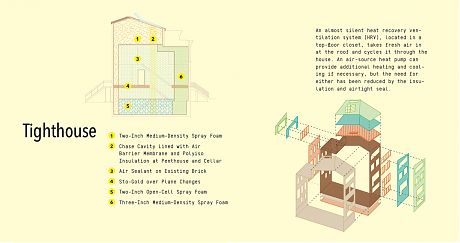
The street facade of New York City’s first certified Passive House, known as Tighthouse, is clad in pale gray stucco, sculpted with a few historic-looking details. But, if you knock on that wall, it sounds hollow: The stucco is merely the outermost layer in a 20-inch-thick insulated sandwich. The original brick is buried deep inside, where it can do no harm—via chinks, cracks, or settling—to the supersealed box this 19th-century, 3,120-square-foot Park Slope house has now become. The cornice, too, is a lightweight contemporary replacement: a hollow fiberglass shell mimicking a wood original.
The smooth, low-maintenance surfaces are a far cry from the derelict three-story row house designer Julie Torres Moskovitz first saw in 2009. The brownstone’s front facade was pocked and cracked, the back wall was falling apart, and the interior left a warren of mystery rooms (including one lined with a one-way mirror). The owners, a young couple just starting a family, weren’t daunted by the damage because they wanted a clean, modern renovation to showcase their art collection. “The owners say they don’t like anything organic,” says Torres Moskovitz. “Only concrete and steel.
Instagramming Around Australia
It’s been quite a while since architecture made my jaw drop. But it did, literally, as I walked down Swanston Street in Melbourne ten days ago. There, in the space of a few blocks, is a collection of buildings so bright, so prickly, so merchanical, so textural that they create their own context. RMIT University, a school of design and technology, has spent the last 20 years hiring local architects to design academic buildings of a type hard to imagine on any of the campuses I’ve studied on. The first on Swanston was Building 8 by Edmond & Corrigan completed in 1993. Its plastic, pastel interiors were described to me as being modeled on an Italian hill town, like the university work of Charles Moore. Its exterior, with tile patterns and palm tree cutouts, part of the diaspora of the ideas of Venturi & Scott Brown, with whom Peter Corrigan studied at Yale in the late 1960s. Edmond is Maggie Edmond, whom Wikipedia says is “probably the nation’s foremost female architect.” Building 8 was joined in 1996 by Storey Hall by ARM Architecture, then in 2011 by Building 22, also ARM. Across the street, a spiny commercial tower calls to the latest edition, Lyons’ Swanston Academic Building, which opened last year and is variously known as the Pineapple, the Porcupine and the Cheese Grater. My own photos of all of these, plus the Cheese, Sean Godsell’s willfully monochrome (yet still ornamented) RMIT Design Hub are in the slideshow below.
After the Museum: The Tumblr
I’ve written several times about Tumblr as a platform for everyday interactions with museums, archives and other collections of visual and historical artifacts (see here, here and most recently here, in “Shopping With Sandro”). One of the benefits of museum Tumblrs and similar projects like the Cooper-Hewitt, National Design Museum’s Object of the Day, is the potential they have to surface items in the collection that have not been exhibited for years, to hold them up next to more current and popular objects, and see what connections happen. The Tumblr can be like a sketch of curation, cheaper and less consequential than an exhibit; or deeper and wonkier on a particular, even personal topic.
Plain or Fancy?
I tried, really I did. But with a vintage Braun coffeemaker and Muji soap dishes, was there any chance I would prefer the items on the Fancy side of the Metropolitan Museum of Art’s tiny new exhibit, “Plain or Fancy? Restraint and Exuberance in the Decorative Arts”? Not really.
I stood in front of the Dutch seventeenth-century nautilus cup—a pearly shell the size of a softball, surmounted with a golden Neptune riding a whale, out of whose mouth Jonah emerges (must not have been against the rules to mix mythologies). I wished the mount away. How much more beautiful would the shell be, how much easier to see its harmonic proportions, without all that glitz? For its owner, however, the unadorned shell didn’t show: the shell, like its neighbors made of stones of sardonyx and jasper, was a precious material without natural glamour. The lily needed gilding in order to demonstrate its worth.
The “Plain or Fancy?” exhibition, which is culled from the museum’s permanent collection of European decorative arts, begs viewers to stand in front of its forty objects and engage in similar internal disputes. Lists of synonyms for plain—masculine, severe, dull—and fancy—flamboyant, ostentatious, vulgar—are painted on walls that are gray and pink, respectively. Both the adjectives and the color choices seem a bit pushy, like putting words in the visitor’s mouth.
Founding Mother: Mariana Van Rensselaer and the Rise of Criticism
In his recent obituary for Ada Louise Huxtable, the Los Angeles Times critic Christopher Hawthorne quotes Wim de Wit, head of architecture at the Getty Research Institute, who describes the first architecture critic for The New York Times as “[speaking] powerfully as a woman in this world of men, the architecture world of the 1960s and ’70s.” This seems undeniably true, but it got me thinking. Huxtable’s crucial contribution was not simply to speak “powerfully as a woman in this world of men.” This she certainly did, splendidly, and from the most powerful media platform of her era; yet it seems important to note that women have been “speaking in this world of men” for a long time now. It’s true that Huxtable, in the early ’60s, pioneered the position of full-time architecture critic in America; and she not only made it her own but also shaped a template that others would follow. But she was not the only female candidate for the job. Not then, not now, not before. As a woman writing about the male-dominated building profession, Huxtable belongs within an admirable historic lineage — a caveat which in no way undercuts her achievements; as a female architecture critic in the early 21st century, this seems to me deeply reassuring.
Patterns of Houston
I just spent two and a half days in Houston preparing to write about two new university art spaces, the James Turrell Skyspace at Rice and WORKac’s addition to the Blaffer Art Museum at the University of Houston. My review will appear in an upcoming issue of Cite, so I will say more about those experiences when that comes out. I did manage to capture the Skyspace’s glorious dawn pink on Instagram. Too bad about the competing light shows on the flanking hospital towers.
Why Bernadette Fox Is Scary
Maria Semple’s novel, Where’d You Go, Bernadette, is a satire of many things. Written in the form of a contemporary epistolary novel, its text links emails, blog posts, itineraries, invoices, police reports and school-home newsletters to tell the tale of one small family beset by a plague of well-meaning locusts. Even the foundations of their house – a former Catholic girls school that overlooks a neighborhood of Seattle’s single-minded Craftsman bungalows – are being undermined by blackberry vines. The father, Elgin Branch, is a Microsoft employee, a TED Talk cult figure, and a classic absent-minded professor, such a genius, so unworldly, that he never notices the status anxieties of his colleagues on the company’s private shuttles. All he cares about is the WiFi.
It’s Toasted: Modernity and “Downton Abbey”
“Is it not enough that we are sheltering a dangerous revolutionary, Mrs. Hughes? Could you not have spared me that?” asks Carson, the butler, midway through last night’s episode of “Downton Abbey.” That is not the mention of the word prostitute at Downton, the Earl’s middle daughter being jilted at the altar, or even the revolutionary Branson appearing at dinner in his daytime suit. That is an electric toaster, a pincher model according to the Cyber Toaster Museum, with a nickel-plated toast rack on top. “I’ve given it to myself as a treat,” says Mrs. Hughes, the housekeeper, placidly. “If it’s any good, I’m going to suggest getting one for the upstairs breakfasts.”
On X
Follow @LangeAlexandraOn Instagram
Featured articles
CityLab
New York Times
New Angle: Voice
Getting Curious with Jonathan Van Ness