That Memphis Moment
Nathalie Du Pasquier placemat, Third Drawer Down
Memphis, the 1980s design movement, is having a moment. The work of Nathalie Du Pasquier appeared on the cover of the Milan Design Week issue of Disegno, and at multiple installations there. Her graphics have been applied to a variety of unwearables by American Apparel. For those over 25, may I suggest the placemats by Third Drawer Down as an alternative. In Memphis (the city), the Dixon Gallery is showing Dennis Zanone’s collection of vintage Memphis, the first US exhibit since a major display at the Cooper-Hewitt in 1986.
1986 was when I first discovered Memphis, in Milan. My family lived there during a seven-month sabbatical and those totemic shapes, those brilliant patterns, turned up everywhere. They remain wrapped up in my mind with the OTT cherubs on sale at Fiorucci, tucked into the historic Galleria, and the more measured prints at Naj-Oleari, where the laminated bookbags featured tiny cars rather than Du Pasquier’s squibs and squiggles. In a bid for most sophisticated high school junior in North Carolina, I wrote a paper on Memphis (I can still visualize the hand-cut cobalt cover), drawing heavily on Barbara Radice’s book.
My favorite Memphis piece, then as now, was leader Ettore Sottsass’s iconic Carlton shelf Its crisp outlines work against the sweetly pastel laminates in a way that is obviously knowing. It walks right up to the edge of tacky and turns up its nose. It is a shelf that, like its right-angle modernist predecessors by Prouve and Perriand, needs to hold nothing.
Why now? Pungent artificiality. Patterns that aren’t supposed to look like anything. Colors not found in nature. The return of Memphis feels like a rebellion against the neo-handicraft era, the fetishization of the hand, the wood surface, the stitch. When even your iPhone cover is meant to look hand-painted, you know the time is ripe for rebellion. Back to plastic! Back to pattern, already creeping (like a fungus, like a vine, like a relief) over architectural facades, basic Gap sweatshirts, sneakers. It’s an admission and exploitation of what is simply a surface. Formica moved from being a tougher imitation of life into an original, often richly referential canvas in the 1950s, Memphis pushed that idea further in the 1980s. Brighter colors, crisper printing, exploitation of the revealing black edge. Memphis, in its own way, was true to its materials. We need a break from our own good taste; Memphis provides an out with intellectual credentials.
Throw off your Breton striped shirts! Embrace the squiggle.
Visit: Jews and Midcentury Modernism
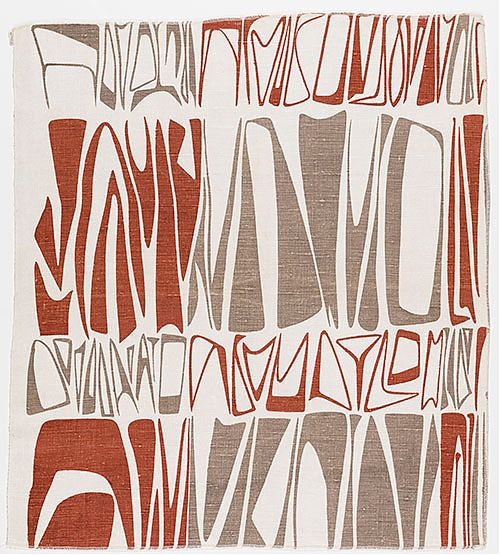
Ruth Adler Schnee, "Cuneiforms" (1947-48). Courtesy Contemporary Jewish Museum.
A new exhibit at the Contemporary Jewish Museum in San Francisco, Designing Home: Jews and Midcentury Modernism focuses on the work of Jewish designers, architects, patrons, and merchants in the creation of the postwar domestic landscape. Curated by Donald Albrecht, the exhibition features work ranging from textiles to photography, graphics to influential developments like the Eichler homes. It should offer a different lens on work that has grown familiar, offering a new interpretation of the networks of schools, museums and corporations that employed Jewish emigres from Europe after WW2.
Love + Architecture
Courtesy Subtle Designer
On February 14, I participated in the symposium What Criticism? at Harvard’s Graduate School of Design, organized by fellow Loeb Florencia Rodriguez. My panel was titled Criticism = Love, after my essay of the same name, and I decided to expand on the theme of hearts and architecture. (It was Valentine’s Day, after all.) You can now watch that video on the site of PLOT, the magazine Florencia founded.

Links: 4.22.14
Photo by Alyse Emdur
“Right, as if the community is this wounded bird.” Rosten Woo in the Los Angeles Review of Books on his new book Willowbrook is …/es…
As I said to my kids this weekend: There are no boy toys or girl toys. There are toys you are interested in, and those that you are not. Antonia Ayers-Brown took this battle to the CEO of McDonalds.
New nomenclature: Usual Landscape Suspects (ULS), attrib. Javier Arbona. With regards to the short list for San Francisco’s Crissy Field parklands.






Visit: Scandinavian Design Preview
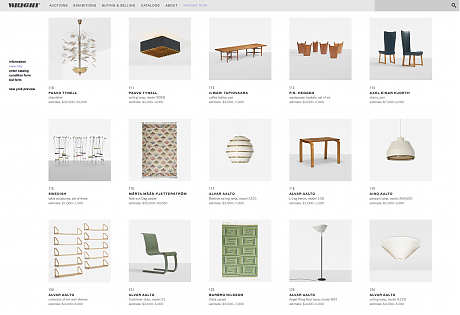
On May 8 Wright20 will hold an auction of Scandinavian modern design in Chicago. Until then, you can visit a selection of rugs, boards, chairs and credenzas at 980 Madison in Manhattan. My covet is the Marta Maas-Fjetterstrom carpets, with their delicate color combinations and intricate geometries.
Wednesday Links: 4.16.14
Courtesy Renzo Piano Building Workshop/Academy of Motion Picture Arts and Sciences
Mid-century modern houses as an endangered species in Architectural Record. Sad how little has changed since I wrote on the same topic for Metropolis in 2003.
A Star Wars creature? The IBM Pavilion at the 1964 World’s Fair? What does Renzo Piano and Zoltan Pali’s Academy of Motion Picture Arts and Sciences’ planned film museum most resemble, besides a mistake?
You may never get to fly first class, but you’ll still enjoy David Owen’s New Yorker feature on James Park Associates and the aesthetics and mechanics of jet comfort.
When Melbourne learned from Las Vegas. Great article on the legacy of postmodernism Down Under. I thought as much when I visited last spring.
Archipsychogeography
n. The city in the critic’s mind made entirely of out-of-date and never built project renderings.
Inspired by.
On X
Follow @LangeAlexandraOn Instagram
Featured articles
CityLab
New York Times
New Angle: Voice
Getting Curious with Jonathan Van Ness