Shopping the Past: Aluminum in Modern Architecture
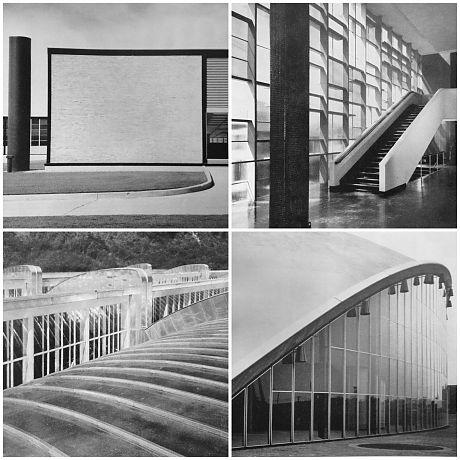
While in the historic town of Micanopy, FL this weekend I got to visit the soon-to-close O. Brisky Books. In the Architecture section I found not only Ada Louise Huxtable’s Kicked A Building Lately? (my favorite book title ever) but the two-volume set of Aluminum in Modern Architecture, published in 1956 with funding from Reynolds Metals. Metals companies clearly understood the power of design to sell their products during this period; Alcoa also sponsored many metal showcases.
Vol. 1 is a trove of projects famous (General Motors Technical Center) and unknown, at least to me (the Zurich airport). I paid $10 for the set, sadly lacking its original aluminum slipcase.
Cloverleaf
I’ve been noticing the track show up in a lot of landscape projects. Now it seems to be entering the building.
Jane Thompson's Calder Brooch

On Wednesday, I hosted a conversation with Jane Thompson about her Zelig-like modernist career at the Harvard Graduate School of Design. Jane covered her time at the Museum of Modern Art, where she was docent at Marcel Breuer’s House in the Museum Garden, her editorial choices at I.D. Magazine (RIP), her involvement with pioneering store Design Research, and her fight to save Faneuil Hall, which transformed it into one of the nation’s ongoing top 10 tourist attractions.
Many in the audience noticed Jane’s spiral brooch. She explained that while she worked at MoMA in the late 1940s, she admired Mary Barnes’s collection of jewelry by “Sandy” Calder. One day she asked him if he would make her something. He drew a spiral on a piece of paper and a few weeks later, this pin arrived in the mail with the note that she owed him $25. “A whole week’s pay!”
Lucia Eames, 1930-2014
Misha Gravenor for Metropolis Magazine
I never met Lucia Eames, but I always think of her as she appeared in the 1976 short film “The Chase,” a demonstration piece for the Polavision Instant Home Movie System. Of course an Eames home movie would have more style than anyone else’s. In the film, Lucia, looking like the Radcliffe graduate she was with glasses, long straight hair, and a denim skirt, is quietly reading on a blanket. The camera pans to a red leather diary, moments before a little boy with a blond bowl cut snatches it and runs away. She gives chase, following him into the Eames House, up the spiral staircase, out the upper story window, and up the Pacific Palisades bluff into which the house is set. In an instant you understand the section of the house, its tight spaces and two levels, its simple frame and idiosyncratic moments. Lucia and the boy are playing with the house and its site, revealing it though motion. One imagines Lucia’s children must often have been called upon to play, whether with toys, furniture, or Hang-It-Alls. She could, and did explain the point of her parents’ work through the simple step of living with it.
Monday Links: 4.7.14
BIG's 'Reverse Aquarium,' courtesy Rebuild By Design
We’re not in Manhattan anymore. New York Mayor Bill de Blasio appoints Tom Finkelpearl, president and executive director of the Queens Museum, as his commissioner of cultural affairs, emphasizing Finkelpearl’s outer-borough activities and emphasis on art for everyone in rhetoric strikingly similar to that used for his appointment of Parks Commissioner Mitchell Silver.
The Indiana Jones of architectural photography? The Wall Street Journal claims Iwan Baan is the profession’s kingmaker, as image trumps all.
Do not touch doesn’t have to mean hands-off: A primer for parents on interacting with museum exhibitions without buttons and lights.
Bjarke Ingels saves Manhattan with BIG U, a protective, landscaped and self-branded berm with parts that could rise up and flip down from Central Park South. See this and nine other resilient regional proposals at Rebuild By Design.
How to Fix New York City's Parks
Xinhua/Eyevine/Redux
In an ideal world, the city would robustly maintain its own seventeen hundred parks without private donations. But that’s unlikely to happen—particularly not as the park budget stretches to accommodate newer parkland on difficult marine and brownfield sites, and has to react to natural disasters like Hurricane Sandy. A tithe, however, is not the only way that private money could make its way to smaller, poorer neighborhood parks.
Why shouldn’t we all have the chance to be John Paulsons, at a hundred dollars, a thousand dollars, or ten thousand dollars a pop, giving to the parks and playgrounds in our own backyards via a network of Neighborhood Parks Conservancies? We would leverage our inherent narcissism to do some good for our daily lives, and the lives of others. The pitch: give to the park you visit every day, rather than the one you go to a couple of times a year.
"We need more museums that let us relax into knowledge"
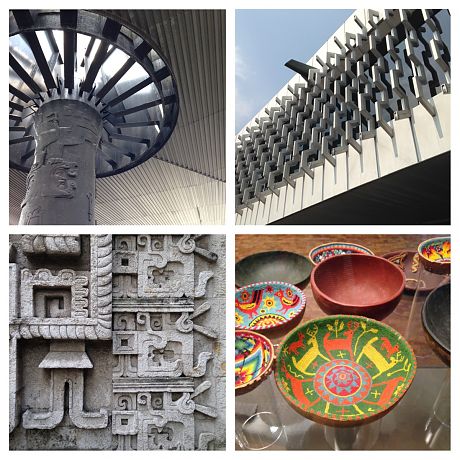
A 1960s institution in Mexico that gives visitors space and time to wander is a stark contrast to the commodified museum experience that has become the norm.
Critics Roundtable: Pritzker Politics
Courtesy Architecture Now
The jury for the Pritzker Architecture Prize has named Shigeru Ban, Hon. FAIA, its 36th laureate, recognizing his material resourcefulness as well as his humanitarian mission as an architect. What the Pritzker Prize means to the industry changes each year with every successive selection (not to mention the architects passed over for recognition). ARCHITECT assembled four writers to break down what it all means: Alexandra Lange (Design Observer; 2014 Loeb Fellow at Harvard GSD), Christopher Hawthorne (Los Angeles Times), Mark Lamster (The Dallas Morning News), and Carolina A. Miranda (ARCHITECT).
On X
Follow @LangeAlexandraOn Instagram
Featured articles
CityLab
New York Times
New Angle: Voice
Getting Curious with Jonathan Van Ness