Nevermind the Masterpiece
Broken Umbrella (photo by Lauren Manning and Veronica Acosta)
To assemble the “Masterpieces of Everyday New York” which currently fill the Sheila C. Johnson Design Center at Parsons The New School for Design, curators Margot Bouman and Radhika Subramaniam asked their colleagues to select objects that brought their city to life. Inspired by the popular book and radio series, A History of the World in 100 Objects, they then used these objects to present 65 stories of different times, places, lives and deaths in the city. Each faculty member contributed a text on their choice, some personal, some academic. In the spare, concrete-floored gallery at Parsons, different objects communicate across the room, and you can move in almost any direction and pick up a narrative thread. The exhibition kicks off a new curriculum for first-year design students that will use New York’s museum collections as text, rather than a textbook, and will begin with the course “Objects as History: From Prehistory to Industrialization.”
How To Unforget
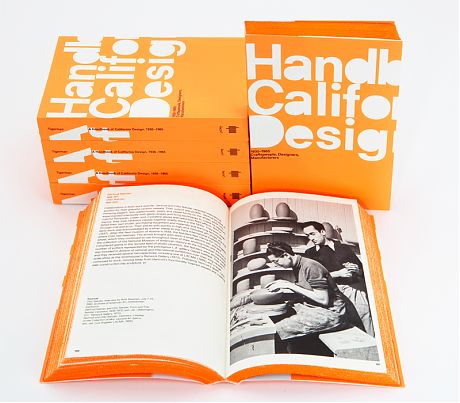
A Handbook of California Design, 1930-1965: Craftspeople, Designers, Manufacturers (Los Angeles County Museum of Art and MIT Press), edited by Bobbye Tigerman (via LAMA)
A few weeks ago Despina Stratigakos published a vigorous call to arms for historians at Places, “Unforgetting Women Architects: From the Pritzker to Wikipedia.“ She writes,
History is not a simple meritocracy: it is a narrative of the past written and revised — or not written at all — by people with agendas. Forgetting women architects has also been imbedded in the very models we use for writing architectural history. The monograph format, which has long dominated the field, lends itself to the celebration of the heroic “genius,” typically a male figure defined by qualities such as boldness, independence, toughness and vigor — all of which have been coded in Western culture as masculine traits. Moreover, the monograph is usually conceived as a sort of genealogy, which places the architect in a lineage of “great men,” laying out both the “masters” from whom he has descended and the impressive followers in his wake. For those seeking to write other kinds of narratives, the monograph has felt like an intellectual straitjacket, especially in contemplating the lives and careers of women who do not fit the prescribed contours.
Stratigakos’s essay serves as a digital call to arms, to get more women into Wikipedia and other online encyclopedias so that (at minimum) their existance cannot be called into question. But digital means are not the only ways of unforgetting, and when I finally picked up the neon orange A Handbook of California Design, 1930-1965: Craftspeople, Designers, Manufacturers, published this spring as a companion and follow-on to the 2012 exhibition at the Los Angeles County Museum of Art, “Living In A Modern Way,” it seemed like another means of unforgetting, one which takes on the monograph form by suggesting that a group biography, emphasizing connections, collaborations and a sort of collective design advancement, might do just as well.
Is Cake Art?

Last winter, the Museum of Modern Art announced the acquisition of fourteen video games, including Pac-Man, Tetris, Myst, SimCity, and Portal. This set off a predictable high-culture call-and-response. In the Guardian, Jonathan Jones defended masterpieces by Jackson Pollock and Pablo Picasso against their new neighbors, arguing that the art is a personal vision, so multi-player games, and the interactive experience, can never be. James Turrell would beg to differ. But it was a stupid question anyway: the games were acquired by the Architecture & Design department, where many creators, and many users, are part of the typical creative process. The step from the iPhone to its apps is less of a leap. The faux controversy did spawn this excellent TED talk, where MoMA curator Paola Antonelli explains “Why I brought Pac-Man to MoMA.”
A less obvious question, raised by baking with and reading Modern Art Desserts, from Blue Bottle Coffee pastry chef Caitlin Freeman, is, Is Cake Art?
Light and Space and Curves

Instagram by ebatesdotcom
In his 1959 review of the Solomon R. Guggenheim Museum for The New Yorker, Lewis Mumford ends with a suggestion that may be his idea of a joke. “I can think of only one way of fully redeeming [Frank Lloyd] Wright’s monumental and ultimately mischievous failure—that of turning the building into a museum of architecture,” he quips. Yet each time the Guggenheim allows an artist to take over the building’s central rotunda, the truth in the witticism is revealed: what looks best in Wright’s building is work that refers to, sets off, qualifies, or amplifies the architecture. It’s almost never architecture itself. Zaha Hadid’s angles clashed with Wright’s curves (2006). Claes Oldenburg and Coosje van Bruggan’s Soft Shuttlecock (1995) merely accessorized them.
James Turrell’s Aten Reign (2013), installed in the rotunda as part of a multi-city retrospective, manages to defy and celebrate the building all at once. As Turrell said at the exhibition’s opening, “Richard [Armstrong, the Guggenheim’s director] was wondering for a while if this was something Frank would like.” A pause like a shrug. “This is an art museum, we are going to put art into it.” At that, he has done a spectacular job.
Every Little Thing
I spent part of last weekend at the Michigan Modern symposium, giving a talk on Alexander Girard, a decade-long inhabitant of the tony Detroit suburb of Grosse Pointe and a longtime designer for Zeeland’s Herman Miller. I heard talks about roadside architecture, the origins of the shopping mall, and the origins of Herman Miller’s ongoing design excellence. Though designers from Detroit (and former furniture capital Grand Rapids) often took their talents to Los Angeles, New York, Santa Fe, all of the participants struggled to define what these famous and not-so-famous names learned from Michigan. I thought the answer was all around us, where we ate, where we listened, where we walked.
Le Corbusier At Moma
Model of the roof terrace of the Unité d’Habitation, Marseille (1946-52). Credit: Fondation Le Corbusier/ARS/ADAGP/FLC.
The psychological center of the Museum of Modern Art’s giant Le Corbusier retrospective, “An Atlas of Modern Landscapes,” is located in the second-to-last gallery. There, taking a few steps in any direction, it’s possible to see many of the Swiss architect’s qualities represented, for better and for worse.
His ardent explanations, for one, which are embodied by wall-size drawings made during lectures on his 1935 trip to America, describing what’s wrong with New York skyscrapers (“not big enough”) and how the traditional peak-roofed house must be replaced by a house on stilts. His attention to reputation, represented by a 1947 collage laying sole claim to the design of the United Nations complex, sketch by sketch. His make-no-little-plans ambition, realized (for once!) in the design of Chandigarh, the new capital of Punjab, in India, seen in plan, drawing, film, photograph, and an arresting six-by-eight-foot wooden model, built by a cabinetmaker and hung on the wall like sculpture. His lifetime exploration of materials, which took him from the delicate hardwood veneer of his mother’s writing desk, designed in 1915-1916, to the curved, chromed tubing of his famous 1928 chaise, or from the white stucco walls of the modernist icon Villa Savoye (1928-31) to the béton brut (rough concrete) of his apartment tower, the Unité d’Habitation in Marseilles (1946-52).
That Personal Touch
In late May, News Corp. released a new logo, seen above, to herald the split of the company into two parts: News Corp. (newspapers and publishing) and 21st Century Fox (entertainment). The logo release was something more than that too: described as being derived from the handwriting of News Corp. founder Rupert Murdoch and his father Keith, the logo seemed to indicate a return to family control, and that Rupert was to be literally hands-on as the corporation shook off its scandal. In the Guardian, Creative Review’s Mark Sinclair noted, “In the era of digital text, handwritten lettering can appear honest, candid even.” Note the can because this artless logo immediately seemed like something else. First, the handwriting of two people cannot be candid. It’s been manipulated, apparently to create a better press release narrative. If you don’t like Rupert, remember his father. It’s also undistinguished. That initial N could never stand as a part for the whole logo, as anyone could write it. And the blobby ends of the N and P suggest Sharpie origins, the bleeding when you let the pen linger too long on your packing box. The black and white looks cheap, which may also have been the point, after a 20th century of geometric symbols and shiny gradients. Scripts are supposed to signal nostalgia, personal connection, with-love-from-me-to-you. But when anyone can make their handwriting into a font, has script lost its meaning?
Praise the Partner(s)
Below is an essay published in Architecture d’Aujourd’hui No. 395, on the topic of the current petiton for the Pritzker Prize committee to recognize the work of Denise Scott Brown, and the larger issues this raises for the practice of architecture and the giving or prizes.
So let’s salute Denise Scott Brown because she deserves it, and because she may indeed be, as Martin Filler put it in the New York Review of Books in 2010, “The World’s Foremost Female Architect.” But let’s not forget the second part of the quote. What needs to shift in architecture is more than making a place for women — it’s making a place for partners. For acknowledging strengths and weaknesses and pretending neither that one guru does it all, not that we can have it all.
Home Improvement
Last week, the editors of The Wirecutter launched The Sweethome, extending their no-nonsense, one-recommendation-per-category approach from tech products to the home. I’ve been a fan of The Wirecutter since its launch, and purchased several items on their recommendation. But I find myself in the market for towels, toaster ovens and toilet paper more often than I am for printers and phones, and the choices for recommendations more limited. The combination of the two categories also fulfills a digital need I spotted long ago, and links to a number of discussions previously held on Design Observer. Below is a short interview with Sweethome editor Joel Johnson. But first, a little background on the issues at hand.
Why Wooden Toys?

Illustration by Zohar Lazar
“Love LEGO but hate plastic?” asked Apartment Therapy in March, just one of more than a dozen design blogs to feature wooden Lego blocks, made by Mokulock, this spring. Described as “handmade” and “all-natural,” the eight-stud-size blocks have clear visual appeal, in the minimalist Muji way, and come packaged in a brown cardboard box, with an unbleached cotton sack for storage. One commenter dreamed of brick and concrete varieties, as well, to teach children about real building materials.
But beyond the blocks’ good looks lurked some very basic questions of function. Design Boom noted a product disclaimer that “the pieces can warp or fit together imprecisely due to the nature of the material in different temperatures and scale of humidity.” Another commenter brought up sustainability, “considering the sheer number of Lego blocks produced a year.” Are Legos even Legos without the universal snap-together property? Do toys need to be as artisanal as our food? I understand why my child would want to make his own toy, but does someone else need to do it for him? And why wood?
On X
Follow @LangeAlexandraOn Instagram
Featured articles
CityLab
New York Times
New Angle: Voice
Getting Curious with Jonathan Van Ness